Social indicators for Circularity

Social indicators for Circularity: a must-have for a systemic era

REGENERATE Fashion, LLC 01/03/2021

The report ‘Fashion Threadsโ€™ that REGENERATE developed in partnership with independent media Modefica, and the Center for Sustainability Studies, FGVces, brings an innovative approach to the circular economy concepts by using social indicators to assess the circularity potential of the three textile fibers analyzed – polyester, cotton and viscose.

This approach was established through the awareness that economies on the Global South are the main producers of raw material for the fashion value chain, and hold a great part of the negative effects of extractivism. 

The report focused on Brazil given that it is the 4th largest producer and the 2nd largest exporter of cotton, and in 2017, was the 10th largest world producer of Textiles.  

To get an idea, Brazil has the largest complete textile chain in the West, and in 2018, the country’s fashion industry employed 1.5 million workers directly. 
Several social issues are related to this worker sector, (informally known as “factory floor” stage) including: unsafe workspaces, slave-like work, subcontracting, lack of protective equipment  for handling  pesticides and chemicals, child labor, among others.

Image credit: MMA Ministรฉrio do Meio Ambiente

The study affirms that these externalities not only bring social-environmental hardship, but also represent economic loss for companies, as people considered โ€˜poorโ€™ remain trapped in the cycle of poverty, rather than entering the economy as  potential customers. 

…externalities not only bring social-environmental hardship, but also represent economic loss…

Other systemic problems, such as the increase in GHG emissions from landfills and dumps, occur due to the lack of a textile waste management policy that integrates the informal waste collection cooperatives. This would mean that waste generation and reduction strategies would potentially affect this informal sector by lacking inputs to carry out its work.

In that sense, maintaining the value of materials indefinitely can only occur if the textile industry considers workers, farmers and marginalized communities as a priority.

The Fashion Threads methodology

To establish the indicators used in the circularity analysis of the fibers, the team developed six theoretical pillars and identified two that have a social focus – Local Conditions: Internalizing Externalities, and Society: Justice and Social Ecology

From there, their circularity attributes as well as social indicators were defined, as follows: 

Supports Local Economy – Policies that facilitate recycling; Policies that facilitate organic farming; Import and export percentages of raw materials,fibers, textiles or finished product, and Potential adoption by consumer; 

Create Jobs – Number and growth rate of new jobs to be created from circular practices; 

Promotes Social Justice – Fiber’s potential to obtain social certifications; Diversity and inclusion within the industry, especially non-white women; Percentage of production in conflict areas; and programs for Informal employment (collectors and cooperatives).

Source: Fios da Moda Report

The potential degree of circularity of the fibers was evaluated based on these criteria, making use of complementary methodologies, such as bibliographic review of 31 life cycle assessment studies (8 of which national, and 23 international), interviews with experts, and development of alternative fiber scenarios.

Source: Fios da Moda Report

The bibliographic review was a basis to  develop the aforementioned social attributes and criteria  based on the Social Life Cycle Assessment methodology (SLCA for its acronyms in English Social Life-cycle assessments). The SLCA framework proposes categories of actors (stakeholders) that represent the groups of human beings most likely to be affected by the activities belonging to a product; and categories of impact (RUSSO GARRIDO, S. 2017). 

It is important to mention that, unlike the environmental impact indicators used in LCA, social impact indicators can be difficult to quantify due to the complexity of finding precise objectives and the challenges in determining which impact categories to include or how to measure some of them.

The study concluded that cotton is the fiber with higher potential to generate a positive impact on social development when applying a circular approach (compared to the other studied fibers: polyester and viscose). 

…the impact of fibers can be improved with public policies to encourage family and ecological agriculture…

Overall, the impact of fibers can be improved with public policies to encourage family and ecological agriculture, strengthened waste management systems – with an emphasis on the informal sector, diligent implementation of the National Policy for Solid Waste in the textile sector, and generation of technical jobs.

The study makes the Call-to-action to the whole fashion system: textile suppliers, retailers, recyclers, cooperatives, the government and consumers alike, to act together as they are all key agents for a circular transformation!


The report ‘FIOS DA MODA (Fashion Threads)’ was financially supported by the Laudes Foundation (formerly C&A Foundation) under the scope of the open call “Making the transition to a circular and inclusive fashion industry.”

To download the English version of Fashion Threads visit: https://reports.modefica.com.br/fashion-threads/

Se preferir ler a versรฃo em Portuguรชs, acesse: https://reports.modefica.com.br/fios-da-moda/

Fashion needs to adopt Life Cycle Thinking

Fashion needs to adopt Life Cycle Thinking

Did you know that the first apparel industry Life Cycle Assessment (LCA) was conducted in 2007 by Levis?

LCA provides detailed information about inputs and outputs present in the manufacturing of a product, but it requires technical knowledge, time and investment to be conducted.

In comparison to in-depth Life Cycle Assessment, Life Cycle Thinking (LCT) is a more accessible way for fashion brands to assess their product’s socio-environmental impacts. This framework does not replace an LCA, but is a great method towards building holistic sustainable products!

But what exactly is Life Cycle Thinking?

“Life Cycle Thinking is a systemic framework that takes a holistic view of the production and consumption of a product or service and assesses its impacts on the environment through the entire life cycle.” (Source: Quantis)

In the process of designing a new product, or re-evaluating an existing one, Life Cycle Thinking, helps to assess the environmental and social impacts at the different stages of the productโ€™s life. This helps to find sustainable alternatives for the resources needed, and to reduce the negative outputs generated.

There are three different scopes in which LCAs are traditionally conducted:

  • cradle-to-gate; from resource extraction to the store.
  • cradle-to-grave; from resource extraction to use-phase and disposal.
  • cradle-to-cradle; from resource extraction to the return of the product or material, back into remanufacturing and use.

At Regenerate, we encourage the companies we work with, to follow the cradle-to-cradle scope, to ensure a circular Life Cycle Thinking framework.

Life Cycle Thinking in the fashion value chain can be stimulated within companiesโ€™ product development teams, with the support of systemic framework exercises, such as our canvas tool in the image.

lifecyclethinking.png

In the training sessions we offer, we use the Life Cycle Thinking Canvas, as the first step to assess a specific product. On each step, we break down inputs and outputs, such as: energy, water, material resources, manpower, chemical discharge, CO2 emissions and waste generation.

For vertically integrated companies, this exercise is straightforward, and the leverage points are easier to reach. In companies with more complex supply chains, identifying inputs and outputs represent a bigger challenge, but through the exercise, teams recognize which suppliers they need to reach out to get this information and map the impacts of their products.

Send us an inbox if you want to know more about our dynamic approach to Life Cycle Thinking and how we can help you in this process.

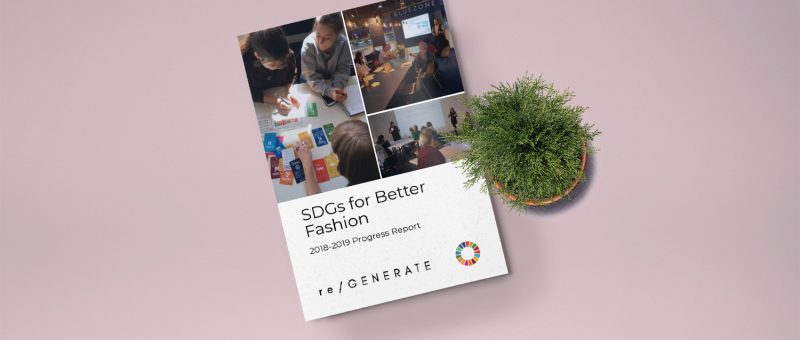
SDGs for Better Fashion

SDGs for Better Fashion: Our commitment to the UN Sustainable Development Goals

By Melissa O de Leรณn

In 2018, we committed to integrate the @UnitedNations Sustainable Development Goals in everything we do.
โ €
Our initiative โ€˜SDGs for Better Fashionโ€™, wide-spreads the connection between the 17 goals and the global fashion industry, and provides strategies to address the environmental and social impacts of fashion production and consumption.

Click here to download our 2018-2019 Progress Report

To follow our initiative on the UN Partnership Platform visit: https://sustainabledevelopment.un.org/partnership/?p=28041

Sustainability and the construction of profit in the textile chain

Sustainability and the construction of profit in the textile chain

by Larissa Roviezzo, REGENERATE’s cofounder

* Article originally posted in FFW fashion portal – Translated from Portuguese

As a sustainability consultant, I have participated in numerous discussions that sought to find sustainable solutions for our industry. Topics such as the use of new materials, companies transitioning the implementation of strategies into the product design phase, application of circularity (strategies that follow the concept of Circular Economy), and the search for obtaining certifications and increasing transparency, among others, are on the rise.  In the midst of so many discussions, I always had the following thought in mind: โ€œwe need to talk about building profit!โ€.

Todayโ€™s fashion industry is established on the ideas of โ€‹โ€‹lower production and purchasing costs, large volume and long term. With this reasoning, factories sell their services at maximum capacity and low value.  Retailers buy at the lowest price to keep their margins high and dilute the cost caused by risks such as: lack of inventory (or excess), freezing of working capital and reduction of the selling price.

Covid-19 showed that the ‘larger order – lower cost’ structure does not leave the industry immune from financial risk when there are no active consumer markets. With that, the wheel that seemed to spin tirelessly stopped, resulting in excessive inventory, suppliers with no payments, and a lack of new orders. In times of crisis, clothing is not considered an essential product. What is essential though  is the source of income for workers in the chain.

Covid-19 showed that the ‘larger order – lower cost’ structure does not leave the industry immune from financial risk when there are no active consumer markets.


Is this business model outdated? The time has come to change the culture of minimal cost and rethink new ways of collaborating.

A SOLUTION

John Thorbeck, president of consulting company Chainge Capital, defends a new model for the textile chain. For him, optimizing Lead Time (moment between when the order is placed by the customer and the effective delivery of the product) and the Just in Time production (everything must be produced, transported or purchased at the exact time), are the keys to reducing risks, and thus costs, in the textile industry.  Two concepts that reduce, for example, the costs of excessive inventory and, consequently, the waste generated at different points in the chain.

For example: Instead of beginning production on a collection six to twelve months in advance, rather produce for a collection that will be launched next month. This model is similar to the business model implemented by Zara, who puts out 12 collections a year. This not for the purpose of stimulating consumption, but rather in terms of speed of production.

It may seem contradictory in terms of sustainability, but in fact this model reduces overproduction and the environmental impacts caused by it. It reduces risks and costs, and, consequently, frees up a larger margin to be used in the cost of the product. In other words, clothing can be sold at a higher price per unit, which will benefit workers in the chain, and provide more resources for retailers to implement the use of sustainable materials and processes in their products – which are currently some of the highest costs.

For this model to succeed, the upstream (suppliers of raw materials, weaving, clothing) and downstream  (distributors, wholesalers, retailers)  relationships of the textile chain need to move closer together, collaborating instead of fighting for the lowest cost. Through this approach the industry will begin to share the risks and the rewards. And of course, it is also crucial to invest in technology, data sharing and strengthening the local supply chain.

Even if the idea of โ€‹โ€‹sustainability has not been attractive to all so far, the capital market shows that the topic is finally being taken seriously. Investors are prioritizing the investment of their capital in companies that meet environmental, social and governance (ESG) criteria. These movements characterize the strengthening of global changes towards more sustainable industries.

Inevitably, times are changing and the current structure of the textile chain does not seem to support the needs of these new times. Quarantine destroyed the illusion that we only prosper individually.

…none of the world’s problems is technically difficult to solve; they arise from human disagreement…

Charles Eisenstein

For this reason also, there is no longer room for us to continue looking for increasingly cheap suppliers and producing unnecessary mountains.

As writer Charles Eisenstein said, โ€œnone of the world’s problems is technically difficult to solve; they arise from human disagreementโ€.

* Article originally posted in FFW fashion portal – To read original article in Portuguese visit: FFW SUSTENTABILIDADE E A CONSTRUร‡รƒO DO LUCRO NA CADEIA TรŠXTIL

Cover illustration source: techpacker.com

8 Design Strategies for a sustainable and circular-oriented fashion

Our Sustainable Fashion Cards feature eight Design Strategies, that provide solutions and different approaches for a more conscious and circularity-oriented clothing development. 

We shared these strategies in a series of posts on our Instagram, and you can access the compiled content below! 

  1. Design for Circularity focuses on choosing long lasting, innovative and/or up-cycled materials, and on ensuring a product is constructed for cyclability. The product’s life cycle extension, further repair possibilities, and recycling or composting are facilitated by design. In addition, the business models in which the product circulates, will also contribute to the material having “infinite value”, for example leasing, swapping, etc.  Our ‘Circular Bags Project’, was developed with major focus on this strategy! To watch the IG TV video where our co-founder Larissa Roviezzo explains it, click here.
  1. Design for Disassembly brings the concept of modular garments, which facilitates material cyclability through Repair, Upcycling, Downcycling or Recycling. The pros of a modular garment are versatility, the possibility to combine materials for the tech and bio cycles, and the use of other non-textile components.  As a case example, Denim Footprint was a project where we created a guideline for denim design and production. Disassembly of collars to enable repairing when worn down, and easy removal of metal buttons to facilitate recycling, where highlighted features.
Credit: KOWA Berlin | denimfootprint.com

  1. Design for User Customization focuses on enabling participation by the user and building an emotional connection to the product. This strategy aims to reduce overproduction & overstock. Production scalability, high costs, and a limited target group may be possible challenges for its implementation.
  1. Ethical Design focuses on improving social impact, strengthening traditions & cultures, and the use of local resources. Besides good intentions, design teams must be conscious about an adequate monitoring of suppliers, and the risks of cultural appropriation.  Watch the IG TV video where our cofounder Melissa O de Leรณn, comments about some interesting Ethical Design case examples.
  1. Positive Design brings benefits to users through garment’s use, and provides innovative solutions to ecosystem’s regeneration. The main challenges comprehend technical difficulties to implement solutions, higher costs, and intense research investment.
  1. Low-No Waste strategy focuses on reducing residues and waste, associated with clothing production! Some of its benefits are the minimisation of environmental impacts, maximisation of material usage, new manufacture possibilities with CAD & 3D printing, and repurposing waste from other industries. Some cons might be, resolving the product’s aesthetics, feel (texture) and performance, and overall design & pattern limitations.   Some case examples are Agraloop technology, which transforms food industry leftovers like rice straw and pineapple leaves into textile fibers; and Brazilian Tsuru Alfaiataria, which has Zero-waste clothing making as a methodology, as well as a philosophy. 

  1. Design with Mono Material is directly associated with the circular approach, and it aims to facilitate the recycling phase at the very end of the use cycle. It also provides the opportunity for the company to work with fewer suppliers, and strengthen those relationships. As for the user, the mono-material product is easier to wash and take care of.  Some constraints faced by the design team would be the limited options for trimmings and components, and also aesthetics challenges. One of the most iconic business cases with this approach was Adidas Futurecraft Loop sneakers launched in 2019, and made out entirely of TPU. Adidas is now researching how to avoid quality loss of this material throughout the recycling loops.
Credit: Adidas
  1. Design for Longevity aims to generate emotional & material durability, promotes the idea of multiple users, inheritance & wearability, and as a consequence, reduces consumption. Some cons would be that timeless designs become more hard to fit trends, and this approach tends to be more adaptable to slow business models.  With a slogan such as “Levis jeans are made to last”, the iconic brand knows how to design for longevity. It’s 1950’S 701 model is a good example for this design strategy. It’s vintage design consolidates as a wardrobe classic and it’s made with 100% cotton – a feature nobody would imagine to be “circularity friendly”.

Which strategy do you think is most relevant in terms of impact? Which of the strategies apply best to your product category?

We will keep following the evolution of these Design Strategies, and how the fashion market and brands will be interpreting them in practice! 

If you have any inspiration or comments to share on the topic, write to us at: hello@regeneratefashion.com

Cover photo: thepangia.com